Wall Street Weathers the NVDA Storm
By Fauzia Timberlake, personal coach for trading options
November 16, 2026
Macro Overview of Markets
Capital markets during the week of November 9th–13th were governed by a tug-of-war between renewed macroeconomic tightening fears and a historic corporate governance shock at the epicenter of the AI trade. On Tuesday, a hotter-than-expected October Consumer Price Index (CPI) report—showing headline inflation running near 4%—revived fears that the Federal Reserve could accelerate its rate-hike trajectory at its December policy meeting, propelling the 10-year Treasury yield decisively above the psychological 5.00% threshold.
While blowout cloud-infrastructure earnings briefly lifted technology sentiment mid-week, Thursday's bombshell announcement that NVIDIA co-founder and CEO Jensen Huang had resigned effective immediately—with CFO Colette Kress stepping in as interim CEO—triggered a sharp rotation out of mega-cap semiconductor leaders and into rival chipmakers, cyclicals, and defensive sectors. Even so, cooler wholesale inflation (PPI) data on Friday helped cushion the tech-led drag, enabling the broader S&P 500 to snap a four-week losing streak.
U.S. equities overcame intense late-week semiconductor volatility to post a solid weekly advance (+2.51% on the S&P 500). After surging early in the week on broad dip-buying and strong AI cloud demand, major indices digested Jensen Huang's abrupt departure from NVIDIA—which erased roughly $490 billion in market value over the week—and pivoted toward rival chipmakers (AMD, Broadcom), energy, and consumer shares.
(S&P 500 Friday Close: 7,561.67)
Fixed-income markets sold off aggressively following Tuesday's sticky October CPI release and Wednesday's Veterans Day holiday. Bond traders repriced the odds of a steeper December Federal Reserve rate hike, driving the benchmark 10-year yield up 29 basis points on the week to settle well above 5%.
(10-Year Treasury Yield Friday Close: 5.15%)
Crude oil experienced a volatile two-way week, sliding early on U.S.-Iran diplomatic signals and International Energy Agency (IEA) estimates of a global supply surplus before rebounding sharply late in the week after attacks on Saudi energy infrastructure and Strait of Hormuz transit risks revived geopolitical risk premiums.
(WTI Crude Oil Friday Close: $87.52)
Precious metals suffered their steepest weekly retreat of the autumn, slicing decisively beneath the $4,000 psychological support level on Thursday as surging 5%+ Treasury yields and a stronger U.S. dollar triggered heavy institutional profit-taking.
(Gold Friday Close: $3,888.40)
Digital assets decoupled from the broader equity rebound, sliding steadily throughout the week as macro yield pressure, persistent spot ETF outflows, and over $1.3 billion in late-week leveraged liquidations dragged Bitcoin below $70,000.
(BTC/USD Friday Close: $68,250.00)
Strategy Corner
Based on last week's market movements, here are some trading ideas and option strategies for the readers' consideration. The positions can be scaled bigger (or smaller) to suit individual account size.
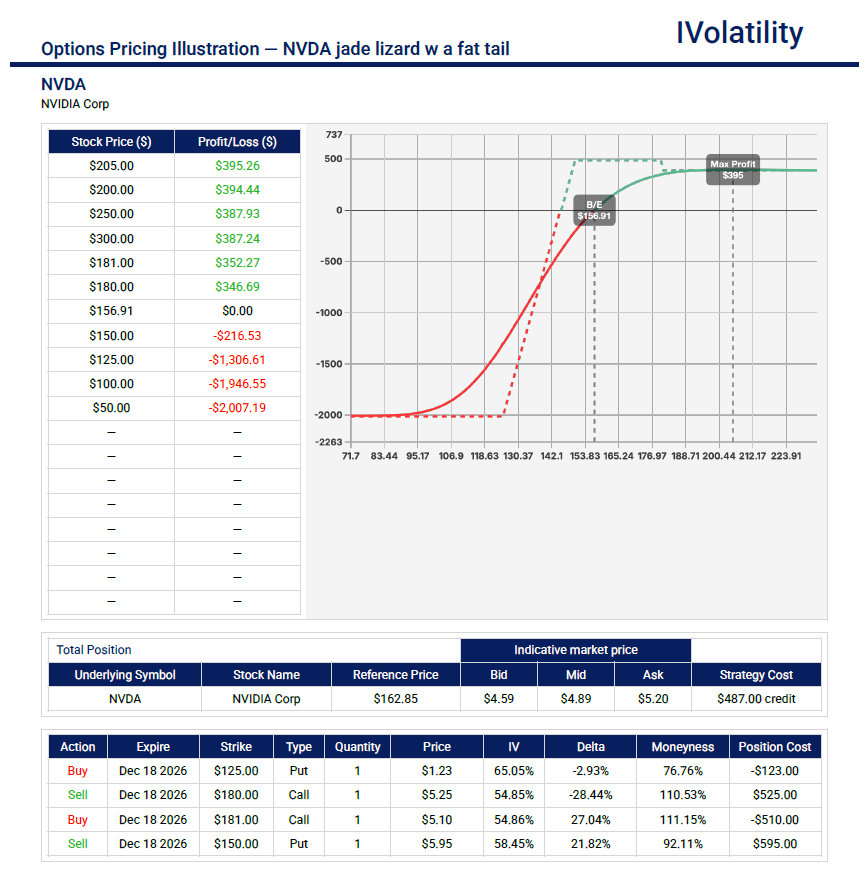
NVDA (closed around 162.82 on Friday, Nov 13th)
Heading into Tuesday's post-market earnings release, NVDA presents a classic divergence between short-term headline panic and long-term fundamental execution. Shares closed Friday down roughly 33% from October's 52-week high of $243.37—after absorbing the shock of co-founder and CEO Jensen Huang's sudden departure and subsequent analyst downgrades. If a trader would like to get cautiously bullish, the following strategy could be used.
- Structure: Jade Lizard (with a tail)
- Position: In the December 18th expiration, sell the 125/150 put spread AND the 180/181 call spread
- Probability of Profit of about 68%
- Credit collected about $490/contract
- Downside breakeven at around 135 (just around the 15delta)
- No risk to the upside (since the call spread width is covered by the credit collected)
- the 125 long put (the tail) does not need to be purchased if the account holder would be comfortable selling a naked put and tying up much more buying power
INTC (closed around 59.67 on Friday, Nov 13th)
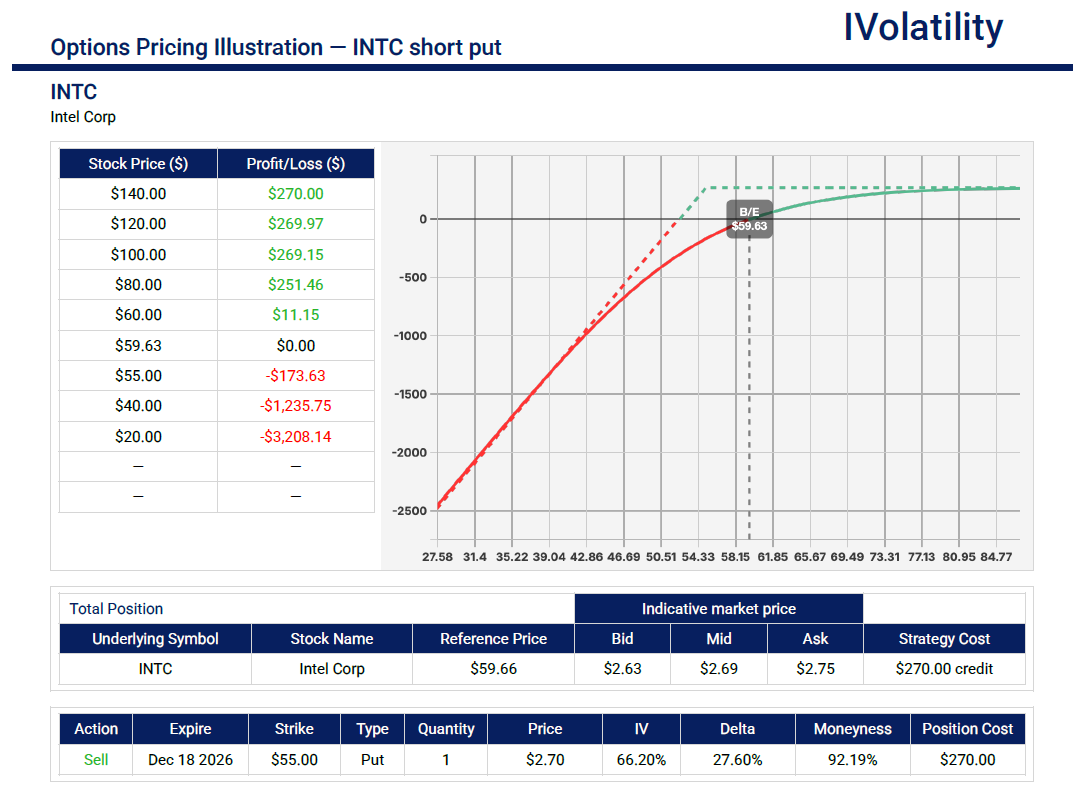
Intel has experienced significant base-building volatility, with shares recently trading around the upper 50s to 60s range. Establishing a short put strike well below the current market price, could offer a meaningful margin of safety against near-term macro noise or sector-wide semiconductor pullbacks.
- Structure: short put
- Position: In the Dec 18th expiration, sell the 55put
- Credit collected about $270/contract
- No risk to the upside
- Downside breakeven is below 53 (55 - premium collected)
Movement of the Major Market Indices:
| INDEX | UP | DOWN |
| SPY | 1.03% | |
| QQQ | 1.52% | |
| IWM | 1.18% | |
| DIA | 0.72% | |
| GLD | -0.73% | |
| BTC/USD | -3.61% | |
| 10-year yield | 5.53% | |
| Crude Oil | 3.39% | |
| VIX | -8.08% |
Movement of the Major Market Sectors:
| SECTOR | UP | DOWN |
| TECH (XLK) | 1.42% | |
| FINANCIALS (XL) | 0.85% | |
| INDUSTRIALS (XLI) | 1.12% | |
| ENERGY XLE | 3.45% | |
| HEALTHCARE (XLV) | 0.40% | |
| UTILITIES (XLU) | -0.25% | |
| MATERIALS (XLB) | 0.65% | |
| REAL ESTATE (XLRE) | -0.85% | |
| CONSUMER STAPLES (XLP) | 1.28% | |
| CONSUMER DISCRETIONARY (XLY) | 1.75% |
Notable Gainers Week of Nov 9th – 13th
Despite pockets of sharp single-stock volatility and heavy profit-taking in select mega-cap tech names, broad equity markets advanced solidly for the week on the back of strong third-quarter earnings beats, FDA regulatory clearances, and aggressive institutional rotation into rival AI semiconductor plays. Outperformers were led by clinical-stage biotech breakthroughs, corporate turnaround stories showing expanding operating leverage, and high-liquidity chipmakers capturing rotated institutional capital. Stocks with daily trading volumes exceeding one million shares attracted decisive buying momentum across both small-cap catalysts and large-cap leaders.
- Focus Universal Inc. (FCUV) (+148.42%): Shares surged from $2.85 to $7.08 on explosive volume, driven by heavy momentum buying around recent corporate filings and a tightly held share float.
- TTEC Holdings, Inc. (TTEC) (+113.77%): The customer-experience technology provider more than doubled after reporting stronger-than-expected third-quarter financial results and reaffirming its full-year 2026 revenue and margin outlook.
- Modine Manufacturing Company (MOD) (+40.42%): The thermal-management and data-center cooling specialist rallied after shareholders approved its corporate rebranding to Modexus Solutions, Inc. alongside renewed institutional demand for AI infrastructure cooling plays.
- Newsmax Inc. (NMAX) (+30.52%): Shares jumped after the media company swung to third-quarter profitability—posting net income of 0.12 per share versus a year-ago loss—fueled by a 77% surge in affiliate fees and new AI content licensing agreements.
- Advanced Micro Devices, Inc. (AMD) (+18.93%): The semiconductor giant advanced on massive daily volume approaching 50 million shares as institutional investors rotated aggressively into rival AI chipmakers.
- Tandem Diabetes Care, Inc. (TNDM) (+18.63%): Shares rose from $16.91 to $20.06 after receiving FDA clearance for its Tandem Mobi system as the world's first tubeless automated insulin delivery system with up to seven days of wear, building on its recent Q3 revenue beat.
- Broadcom Inc. (AVGO) (+18.16%): The custom AI silicon and infrastructure software leader climbed from $293.69 to $347.01 (after rallying as much as 24% through Thursday) on heavy institutional inflows into custom AI accelerators.
Notable Losers Week of Nov 9th – 13th
While the broader equity indices rebounded into positive territory for the week behind strength in energy and industrial stocks, sharp single-stock sell-offs punished companies that delivered disappointing third-quarter earnings, slashed full-year guidance, or suffered clinical trial setbacks. Institutional sellers aggressively rotated out of high-valuation AI semiconductor leaders, debt-burdened media operators, and biopharma names facing pipeline or commercialization headwinds, driving heavy distribution volume across names trading well above one million shares daily.
- Zura Bio Limited (ZURA) (dropped nearly 70%): Shares plunged after the clinical-stage biotech announced that its Phase 2 TibuSHIELD trial failed to meet its primary endpoint, triggering heavy institutional liquidation.
- iHeartMedia, Inc. (IHRT) (dropped over 66%): The audio media operator tumbled after reporting weaker-than-expected third-quarter revenue and cutting full-year EBITDA guidance amid soft broadcast radio political ad spillover and high debt leverage.
- Microvast Holdings, Inc. (MVST) (dropped over 65%): Shares sank following third-quarter results showing a 62.8% year-over-year revenue drop, heavy inventory write-downs, and unresolved going-concern doubts tied to near-term debt negotiations.
- Sable Offshore Corp. (SOC) (dropped over 62%): The offshore energy producer slid after disclosing that its sole crude oil buyer suspended purchases due to refinery upgrades and maintenance, prompting a going-concern warning over potential liquidity constraints.
- Cardinal Infrastructure Group Inc. (CDNL) (dropped over 56%): Shares fell sharply on the week fafter quarterly margin compression and upward construction project-cost revisions drove a roughly $11 million net loss.
- Ionis Pharmaceuticals, Inc. (IONS) (dropped over 26%): The biotech developer dropped after management sharply reduced its sales forecast for its triglyceride-lowering therapy TRYNGOLZA, sparking widespread analyst target cuts.
- Kanzhun Limited (BZ) (dropped over 26%): The Chinese online recruitment platform declined amid pre-earnings caution over softer corporate hiring trends, rumors of cautious forward revenue guidance, and broad selling across Chinese tech ADRs.
- Hims & Hers Health, Inc. (HIMS) (dropped over 24%): Shares retreated as investors reacted to softer forward revenue guidance and gross margin compression tied to a shifting product mix toward branded weight-loss treatments.
- NVIDIA Corporation (NVDA) (dropped over 13%): The AI chip bellwether logged its steepest weekly drop since April 2025—sliding from $186.64 to $162.14 on massive volume—amid CEO behavior woes regarding improper behavior and reckless alliances, regulatory scrutiny headlines, institutional profit-taking, and pre-earnings valuation digestion.
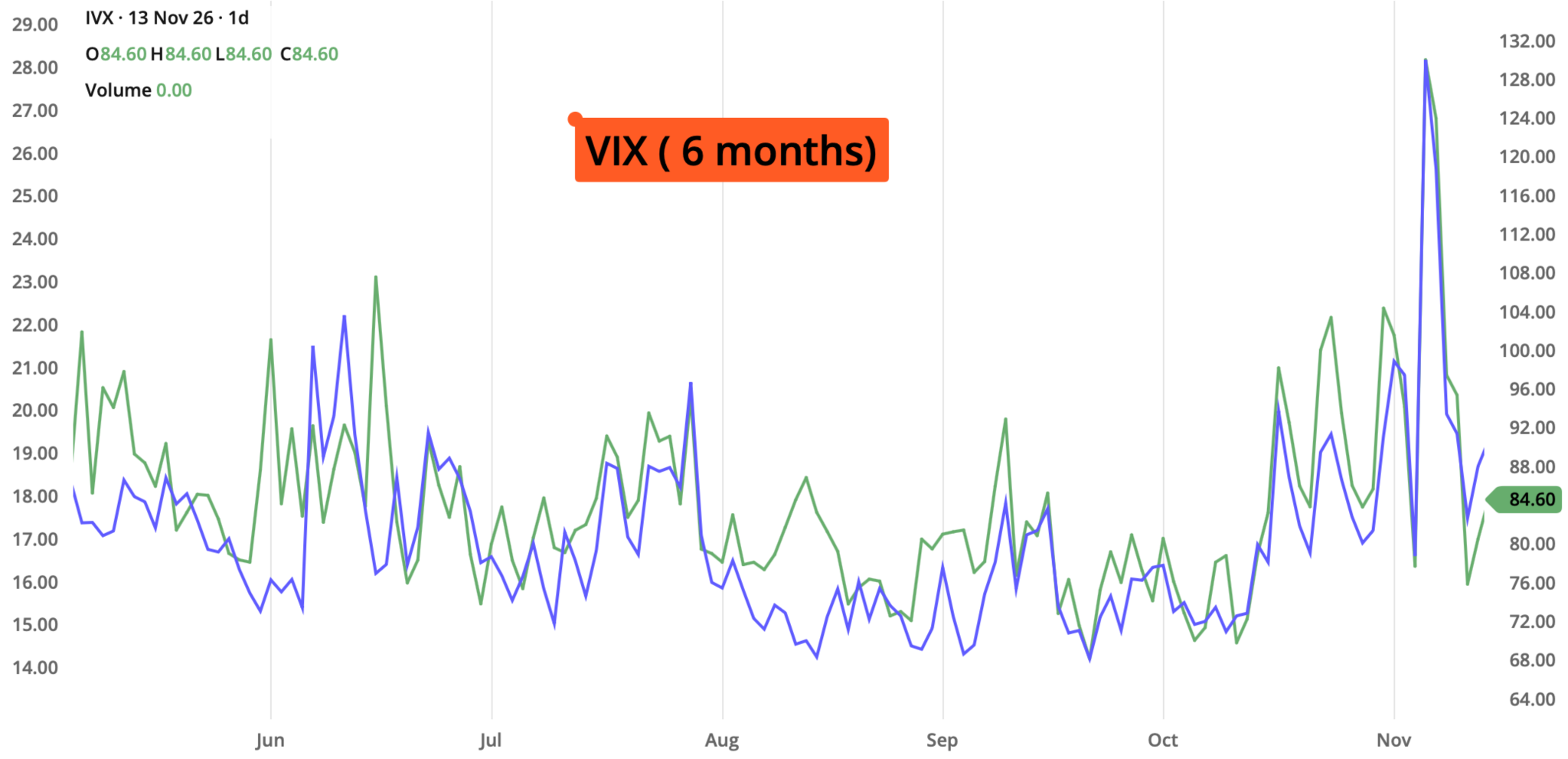
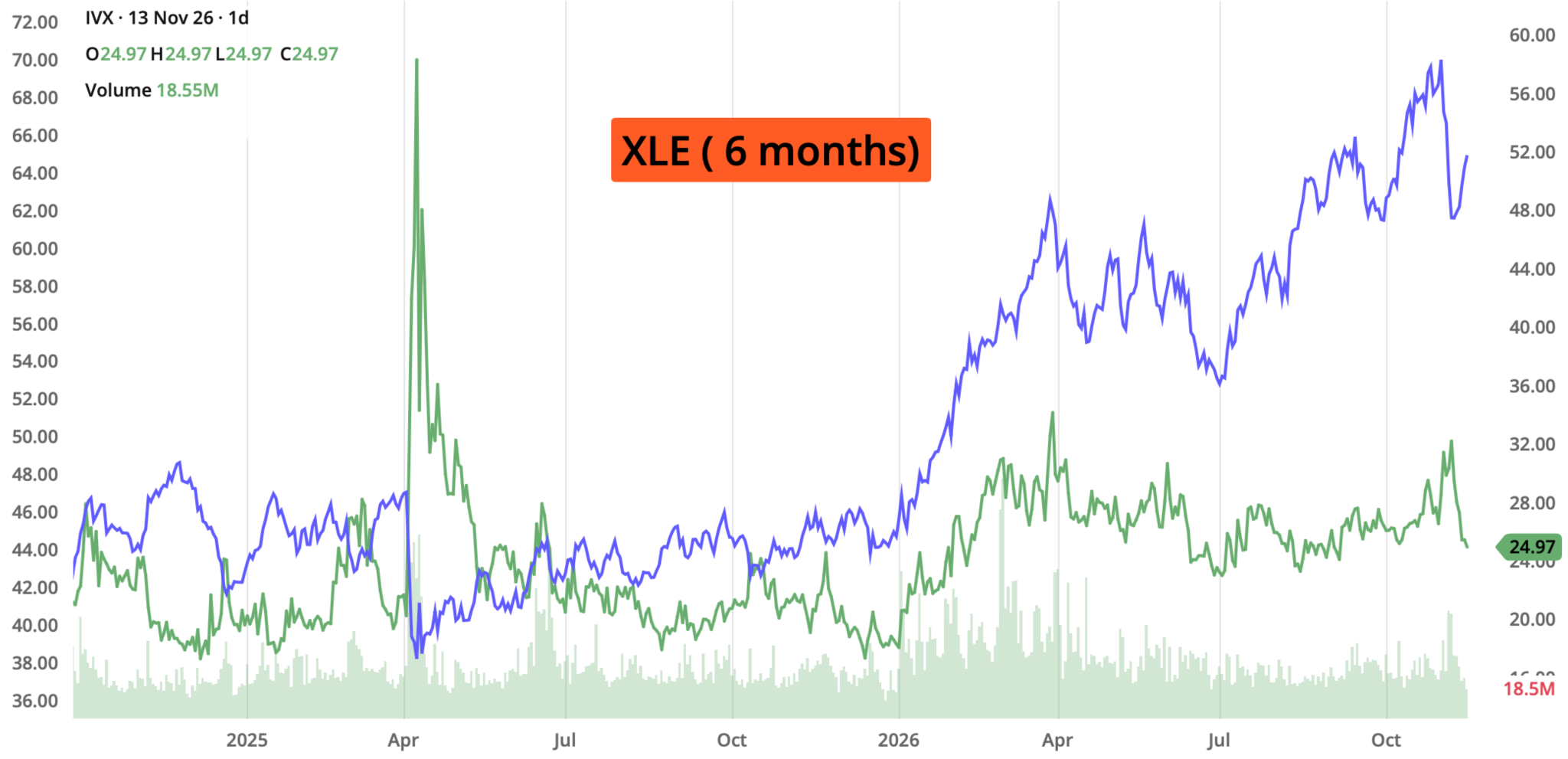
Review selected market indices below:
Daily Notable Market Action
Market Summary for Monday, Nov 9th
Equities: Major benchmarks staged a broad relief rally as institutional dip-buyers stepped aggressively back into equities and chipmakers, shrugging off early regulatory inquiry headlines surrounding NVIDIA.
(S&P 500 Close: 7,549.94)
Bonds: Treasury yields ticked 2 basis points higher in quiet pre-CPI positioning as fixed-income desks braced for Tuesday's October inflation report.
(10-Year Treasury Yield Close: 4.88%)
Oil: WTI crude oil plunged more than 3% to start the week as diplomatic talks between Washington and regional leaders eased immediate Middle East supply disruption fears.
(Crude Oil Close: $86.85)
Gold: Gold climbed nearly 1%, reclaiming the $4,100 threshold on early-week hedging flows ahead of key inflation data.
(Gold Close: $4,114.50)
Digital Assets: Bitcoin decoupled from the equity surge, slipping 1.37% below $75,000 as spot Bitcoin ETFs logged heavy weekly redemptions.
(BTC/USD Close: $74,740.00)
Market Summary for Tuesday, Nov 10th
Equities: Stocks surrendered a modest portion of Monday's gains after hotter-than-expected October CPI data revived hawkish rate-hike concerns and weighed on high-valuation technology shares.
(S&P 500 Close: 7,520.93)
Bonds: Treasury yields jumped 10 basis points—pushing right up to the psychological 5.00% threshold—as bond traders repriced the probability of an aggressive December Federal Reserve rate hike.
(10-Year Treasury Yield Close: 4.98%)
Oil: WTI crude oil extended its slide, testing 10-week lows on renewed U.S.-Iran diplomatic optimism and a surging U.S. dollar.
(Crude Oil Close: $86.04)
Gold: Gold futures dropped more than 2% as spiking Treasury yields and a stronger dollar triggered sharp profit-taking across precious metals.
(Gold Close: $4,030.20)
Digital Assets: Bitcoin bucked the weakness in stocks and gold, edging up 0.70% to reclaim the $75,200 level in resilient range-bound trade.
(BTC/USD Close: $75,267.00)
Market Summary for Wednesday, Nov 11th
Equities: Equities surged as blowout cloud-infrastructure earnings from CoreWeave and renewed IPO momentum for Anthropic reignited the AI trade across mega-cap technology.
(S&P 500 Close: 7,619.38)
Bonds: Cash Treasury trading was closed for the Veterans Day holiday
Oil: WTI crude oil rebounded off multi-week lows as lingering uncertainty over Middle East conflict risks offset recovering Persian Gulf export flows.
(Crude Oil Close: $87.25)
Gold: Gold extended its pullback, fading an early morning bounce to settle right at the $4,000 psychological support level.
(Gold Close: $4,000.50)
Digital Assets: Bitcoin slid back below $74,000 as digital assets lagged the tech rally amid a fifth straight session of spot ETF outflows.
(BTC/USD Close: $73,721.00)
Market Summary for Thursday, Nov 12th
Equities: Major indices pulled back as shockwaves from NVIDIA CEO Jensen Huang's sudden resignation rattled semiconductor stocks alongside persistent rate-hike jitters.
(S&P 500 Close: 7,592.40)
Bonds: Returning from the mid-week holiday, bond sellers pushed the 10-year Treasury yield decisively through 5.00% to 5.10% as hawkish Fed rate expectations intensified.
(10-Year Treasury Yield Close: 5.10%)
Oil: WTI crude oil jumped roughly 2.5% after reports of tanker explosions in the Strait of Hormuz and attacks on Saudi energy infrastructure reignited supply-disruption fears.
(Crude Oil Close: $88.74)
Gold: Gold suffered a steep sell-off, slicing below $4,000 per ounce to log its lowest settlement of 2026 under the weight of 5.10% yields and a multi-month high in the U.S. dollar.
(Gold Close: $3,885.30)
Digital Assets: Bitcoin dropped sharply, breaking below $72,000 as rising yields and risk-off sentiment triggered heavy leveraged liquidations.
(BTC/USD Close: $71,343.00)
Market Summary for Friday, Nov 13th
Equities: Stocks slipped modestly in choppy trade as cooler-than-expected October wholesale inflation (PPI) cushioned ongoing semiconductor weakness, allowing the S&P 500 to snap a four-week losing streak with a +2.51% weekly gain.
(S&P 500 Close: 7,561.67)
Bonds: Treasury yields climbed another 5 basis points as Wall Street banks adjusted forecasts to price in multiple upcoming Federal Reserve rate hikes.
(10-Year Treasury Yield Close: 5.15%)
Oil: WTI crude oil fluctuated in a tight range, holding near the $88.50 level into the weekend as traders weighed competing diplomatic signals against Strait of Hormuz transit risks.
(Crude Oil Close: $88.56)
Gold: Gold stabilized in quiet, range-bound trade, pausing its three-day slide just below $3,900 as the U.S. dollar consolidated following the morning's PPI release.
(Gold Close: $3,888.40)
Digital Assets: Bitcoin fell roughly 4.3%—marking its weakest Friday the 13th on record—as over $1.3 billion in leveraged crypto liquidations pushed prices down through $70,000.
(BTC/USD Close: $68,250.00)
Notable Earnings Due for week of Nov 16th–20th
The corporate earnings calendar for the week of November 16th–20th shifts decisively toward the U.S. consumer, big-box retail, and the centerpiece of the AI trade. Needless to say, after the week's alarming news regarding ex-CEO Jensen Hwang, all eyes will be on NVIDIA (NVDA) after Tuesday's closing bell for a critical read on enterprise AI infrastructure demand and forward guidance. Throughout the week, a heavy wave of major retailers will provide direct insight into consumer spending health, pricing power, and early holiday demand, complemented by major Chinese e-commerce and tech ADRs.
The actual earnings date may vary, so traders should confirm with their brokers. If a trader wishes to open a position to participate in earnings announcements, it is important to check whether the earnings are released BEFORE the markets open or AFTER the markets close on the date of earnings.
Mon, Nov 16th:
BEKE / BIDU / HTHT / PAGS / TCOM / TSN / XP / XPEV
Tue, Nov 17th:
AS / DIS / FUBO / HD / JD / KLAR / NVDA / SQM / TME / VIK / ZTO
Wedn, Nov 18th:
BLSH / HAFN / HP / LOW / P / PANW / PONY / SBLK / TGT / TJX / ZIM
Thu, Nov 19th:
BABA / BBWI / CPRT / ESTC / FUTU / GAP / INTU / KEYS / NTES / PDD / ROST / WMG / WMT / WSM / YMM
Fri, Nov 20th:
BJ / BMNR / FRO / VFS
Economic Calendar Due for week of Nov 16th–20th
The macroeconomic schedule for the week of November 16th–20th shifts from headline inflation reports to consumer spending, manufacturing activity, and housing resilience, punctuated by the release of the October FOMC meeting minutes. Following hotter-than-expected October CPI data and elevated mortgage rates that have weighed on real estate turnover, investors will scrutinize Tuesday's Retail Sales report and Wednesday's Fed minutes for clues on consumer durability and central bank policy. Regional factory surveys and late-week sentiment readings will further test whether economic momentum is holding steady heading into the year-end holiday season.
Monday, November 16th
- NY Fed Empire State Manufacturing Index
This monthly survey gauges manufacturing business conditions, new orders, and input prices across New York State. As the first regional factory reading of the month, sharp swings in activity or prices-paid components often set the early tone for industrial sentiment and inflation expectations.
Tuesday, November 17th:
- Retail Sales (October)
Retail Sales measures total consumer spending across brick-and-mortar and online merchants, serving as the market's primary pulse check on household demand. Because consumer spending drives roughly two-thirds of U.S. GDP, upside or downside surprises heavily influence equity sector rotation and rate expectations. - Import & Export Price Indices (October)
These indices track price changes in goods traded between the U.S. and foreign partners, capturing currency effects and global commodity pressures. Sustained increases can signal imported pipeline inflation that may eventually filter through to consumer prices. - Industrial Production & Capacity Utilization (October)
This release measures the real output of U.S. manufacturing, mining, and utilities alongside the percentage of industrial capacity currently in use. Rising utilization rates point to healthy economic expansion, though readings near historical ceilings can flag potential supply bottlenecks. - Business Inventories (September)
Business Inventories tracks the dollar value of goods held by manufacturers, wholesalers, and retailers relative to monthly sales. Shifts in the inventory-to-sales ratio help investors assess whether companies are restocking for future demand or facing an unwanted buildup of unsold goods. - NAHB/Wells Fargo Housing Market Index (November)
This survey measures homebuilder confidence regarding current single-family sales, six-month sales expectations, and prospective buyer traffic. With mortgage rates hovering near multi-year highs, builder sentiment provides an early read on residential construction appetite.
Wednesday, November 18th
- Housing Starts & Building Permits (October)
Housing Starts tracks the number of new residential construction projects begun during the month, while Building Permits serves as a forward-looking indicator of future construction activity. Together, they reveal how strongly higher borrowing costs are constraining new housing supply and construction-related sectors. - FOMC Meeting Minutes (October Policy Meeting)
The detailed minutes from the Federal Reserve's October policy meeting provide insight into policymakers' internal debate over inflation persistence and the future trajectory of interest rates. Market participants will parse the language closely for consensus—or dissent—around potential rate moves in December.
Thursday, November 19th
- Weekly Initial & Continuing Jobless Claims
This weekly report tracks new and ongoing filings for unemployment benefits, offering the timeliest gauge of labor market health. Any sustained uptrend in claims would signal softening employment conditions, whereas historically low readings reinforce labor tightness. - Philadelphia Fed Manufacturing Index (November)
Covering the Mid-Atlantic region, this survey tracks factory activity, employment, and pricing pressures. Alongside the Empire State report, it provides a broader cross-check on whether domestic manufacturing is expanding or contracting. - U.S. Leading Economic Indicators (October)
This composite index aggregates ten forward-looking economic variables—including average weekly hours, new orders, and yield spreads—to forecast turning points in the business cycle. Consecutive monthly declines often raise caution flags around slowing macroeconomic momentum.
Friday, November 20th
- University of Michigan Consumer Sentiment Index (Final November)
This final monthly survey updates consumer attitudes toward personal finances, business conditions, and inflation expectations. Wall Street pays particular attention to the 1-year and 5-year inflation expectation sub-indices to ensure long-term price expectations remain anchored.
Blue Sky Horizons
The Next Frontier: Physical AI, Humanoid Robotics, and the Industrial Automation Shift (part 2)
Last week, we introduced the structural pivot from digital software intelligence to Physical AI—the convergence of foundation models, spatial perception, and embodied robotics. As we move deeper into late 2026, the core narrative across institutional research and capital allocation has shifted from hardware novelty to scalable infrastructure and commercial deployment.
For decades, industrial automation meant bolted-down, single-purpose robotic arms isolated inside safety cages. Today, two major inflection points are dismantling those boundaries:
- From Rule-Based Programming to Vision-Language-Action (VLA) Models: Instead of writing brittle, line-by-line code for every movement, modern robotic fleets are increasingly powered by VLA foundation models and synthetic "digital twin" simulations. By training in hyper-realistic virtual environments before ever hitting the factory floor, machines can adapt to unstructured, real-world variables—such as picking irregular items in a warehouse or navigating dynamic human workspaces—while driving down teleoperation and data-collection costs.
- Brownfield Economics & Robotics-as-a-Service (RaaS): Traditional automation often required redesigning an entire facility from the ground up. Humanoid and mobile-manipulator form factors are specifically engineered for "brownfield" environments—existing warehouses, assembly lines, and retail backrooms built for human dimensions, stairs, and narrow aisles. Coupled with flexible RaaS leasing models that convert heavy upfront capital expenditures into predictable monthly operating expenses, enterprise pilots in automotive manufacturing, logistics, and quick-service food prep are steadily transitioning into multi-unit commercial rollouts.
As IT (data processing and agentic AI) merges with OT (operational machinery and sensors), the defensible moat is moving up the stack—favoring the compute providers, machine-vision specialists, and integrated automation platforms that serve as the "nervous system" of the autonomous economy.
TAKEAWAYS
Self-directed investors looking to gain exposure to the emerging physical AI and advanced robotics supply chain may consider tracking these high-liquidity market leaders for their focus lists:
- NVIDIA Corporation (NVDA): A primary enabler of robotics development through its specialized Jetson edge-AI modules, Omniverse simulation platform (used for training autonomous physical agents), and robotics reference architectures.
- Tesla, Inc. (TSLA): Positioned at the forefront of physical AI scale through its proprietary autonomous driving neural networks and ongoing commercial development of the Optimus humanoid robot.
- Intuitive Surgical, Inc. (ISRG): The clear market leader in high-precision robotic surgery platforms, demonstrating a proven commercial track record of integrating advanced machine vision and robotic execution into medical workflows.
- Rockwell Automation, Inc. (ROK): A pure-play industrial automation and digital transformation provider equipping global manufacturers with the hardware infrastructure, sensor arrays, and software systems required for next-generation factory floors.
- Symbotic Inc. (SYM): An emerging leader in AI-driven, high-speed warehouse and supply chain automation, providing scalable robotics solutions for mega-retailers and logistics networks.
Thank you for reading. Until next week's close,
Have a safe and productive Trading week!
Fauzia Timberlake
About the Author: Fauzia Timberlake is a professional options coach and financial strategist specializing in risk management and portfolio architecture for self-directed investors. She is Founder and Managing Partner of Option Engines.
Questions / Comments
We're here to serve IVolatility users and we welcome your questions or feedback about the option strategies discussed in this newsletter. If there is something you would like us to consider and/or analyze, we're always open to your suggestions. Use support@ivolatility.com.
Previous issues are located under the Trade Ideas tab on our website.