The Energy Squeeze: Oil Rallies While Growth Equities Retreat
By Fauzia Timberlake, personal coach for trading options
October 26, 2026
Macro Overview of Markets
A sharp acceleration in global energy supply fears alongside persistent pressure from elevated Treasury yields continued to weigh on broad equity valuations. Spurred by escalating geopolitical risk in the Middle East, crude oil breached multi-year highs while benchmark yields anchored near critical psychological thresholds. This environment kept high-valuation growth sectors under pressure while driving selective capital flows into defensive assets and commodity-linked sectors.
U.S. equities experienced notable chop and internal divergence over the period, ultimately finishing lower on the week. Broad market indexes faced persistent headwinds as sustained capital expenditure demands in technology coincided with rising input costs across heavy industry and transport. While defensive components and energy-related equities provided isolated support throughout the week, selling pressure picked up into Friday's close, leaving index benchmarks nursing back-to-back weekly losses.
(S&P 500 Close: 7,623.68)
Fixed-income markets saw yields drift slightly lower mid-week before rebounding sharply into the weekend, as persistent inflation risks capped buying interest. The 10-year Treasury yield fluctuated before settling right at the key 5.00% mark, keeping financial conditions tight and maintaining downward pressure on long-duration equities.
(10-Year Treasury Yield Close: 5.00%)
Crude oil demonstrated aggressive upward momentum, extending its advance well past key multi-year levels. Driven by Middle East supply disruption concerns, tightening global inventories, and sustained physical market tightness, energy markets continued to trend higher despite ongoing macroeconomic headwinds.
(Crude Oil Close: $103.27)
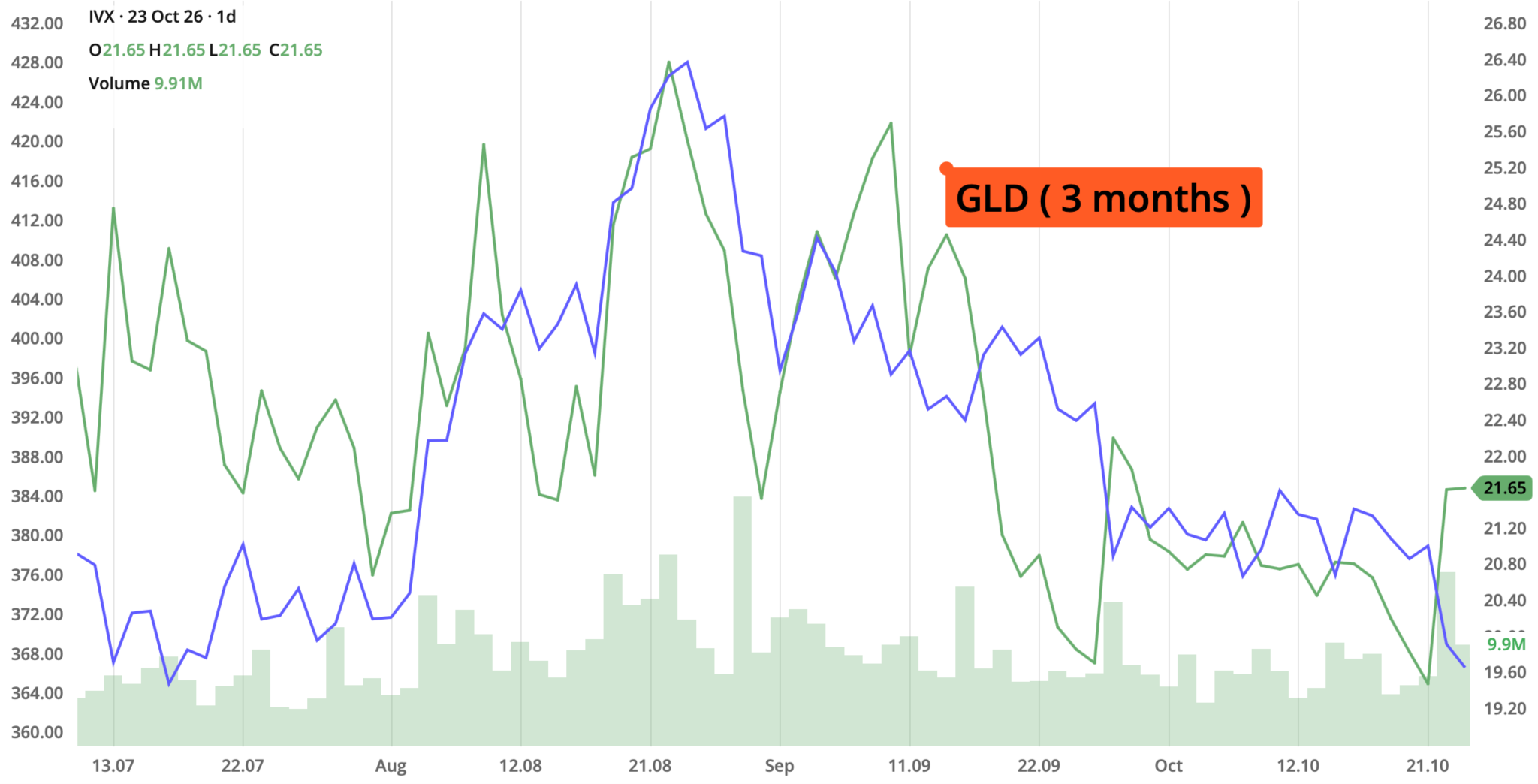
Precious metals faced moderate profit-taking over the course of the week following recent historic highs. Although safe-haven demand remained active, headwinds from elevated real yields and a firming U.S. dollar prompted gold prices to pull back below recent peak thresholds to settle near key psychological support.
(Gold Close: $3,999.90)
Digital assets remained largely range-bound, consolidating within a defined technical channel. Bitcoin and major altcoins traded with subdued directional volume, tracking broader risk-off equity sentiment while holding key multi-week support levels intact.
(Bitcoin Close: $81,076.80)
Strategy Corner
Based on last week's market movements, here are some trading ideas and option strategies for the readers' consideration. The positions can be scaled bigger (or smaller) to suit individual account size.
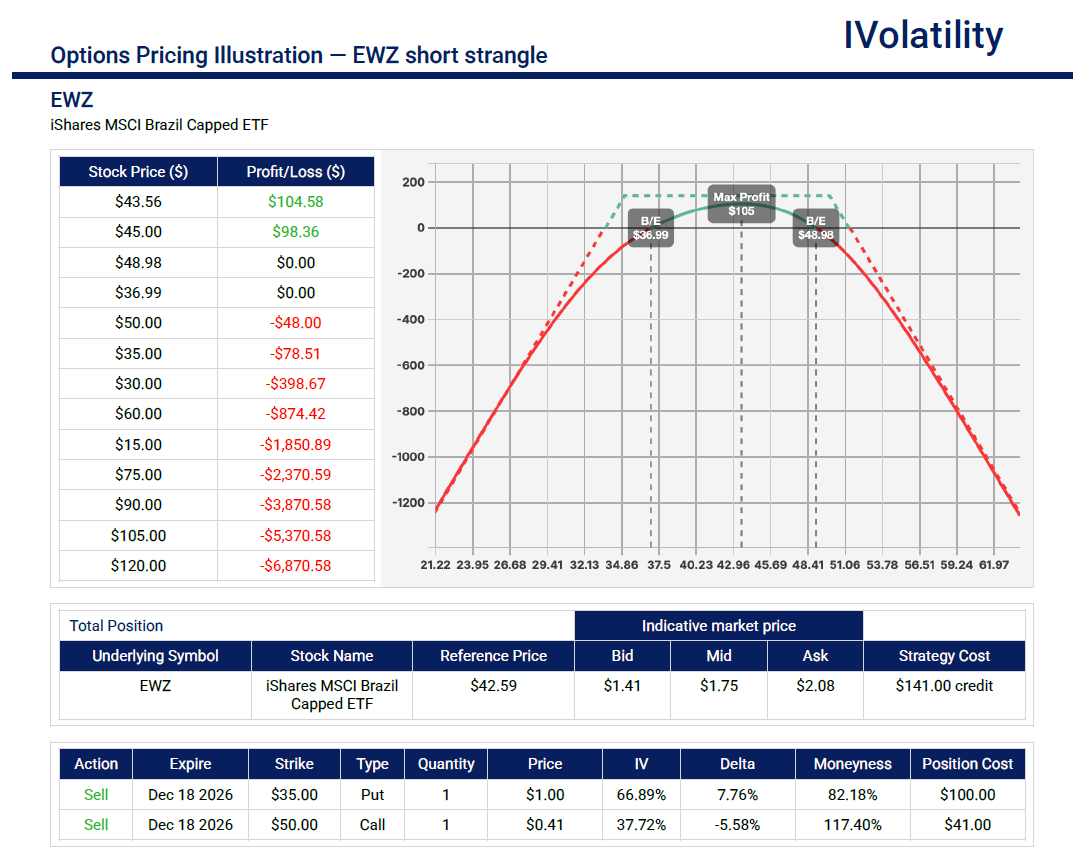
EWZ (closed around 42.58 on Friday, Oct 23rd)
Brazil's primary equity drivers—state-backed energy and materials giants like Petrobras (PBR) and Vale (VALE)—are benefiting from firm global crude oil and raw material prices. However, broader emerging market equity flows are being checked by elevated U.S. Treasury yields and a strong U.S. dollar. This tug-of-war between fundamental commodity tailwinds and macro rate headwinds could likely keep EWZ range-bound through year-end.
If a trader would like to be neutral in EWZ for the next 54 days, then a short strangle could be considered.
- Structure: short strangle
- Position: In the Dec monthly expiration, sell the 35/50 strangle
- Probability of Profit of about 60%
- Credit collected about $175/contract
- Breakevens at about 33.5 and 51.5
COST (closed around 1003.32 on Friday, Oct 23rd)
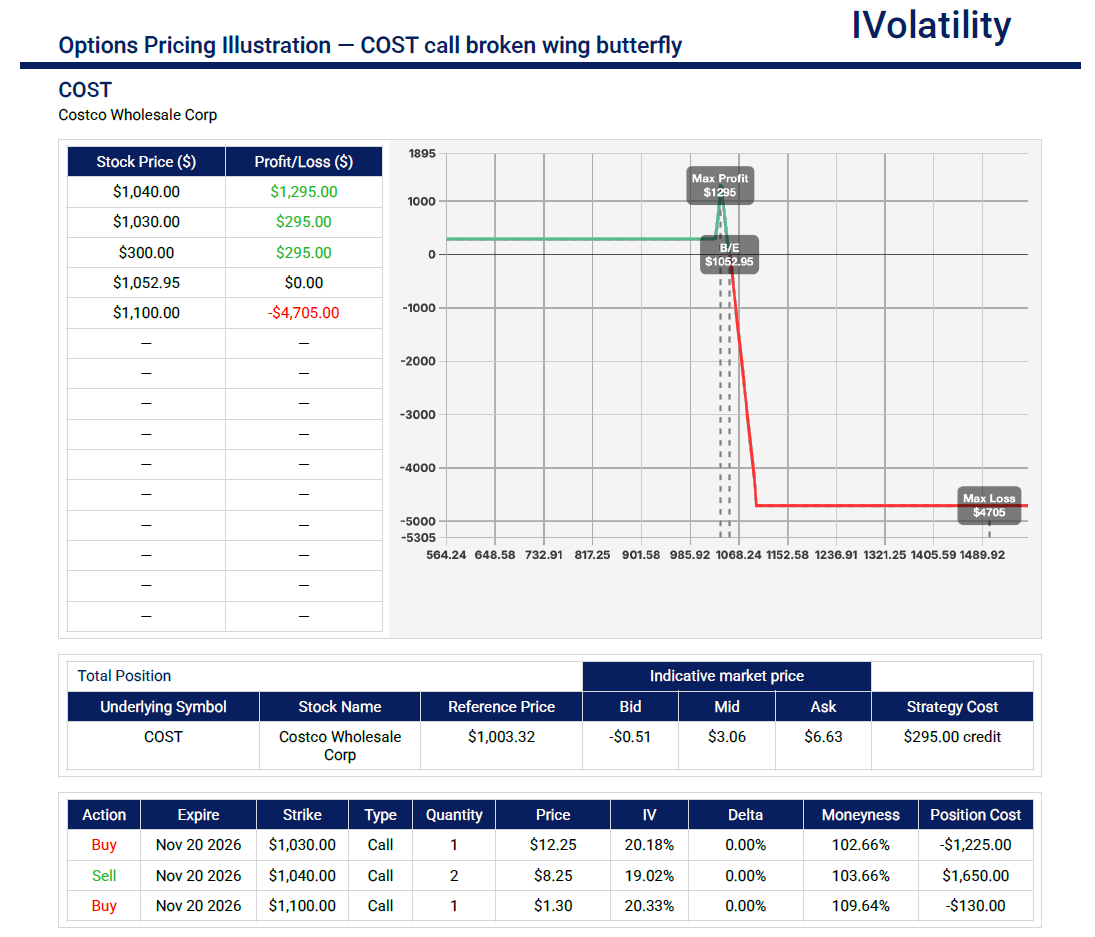
Over the past month, COST has exhibited a strong, steady upward trend, breaking out from the low-$900s at the start of October to test new milestone highs above the $1,000 threshold. Given this runup, a trader might consider a call broken-wing butterfly if comfortable with a breakeven at around the 26 delta in November.
- Structure: Call broken-wing Butterfly
- Position: In the November monthly expiration, buy one 1030call / sell two 1040calls / buy one 1100call (to limit buying power)
- Probability of Profit about 79%
- Credit collected about $300
- Maximum potential profit about $1300 if COST pins 1040 at expiration
- No downside risk; upside breakeven is just above 1050
Movement of the Major Market Indices:
| INDEX | UP | DOWN |
| SPY | -1.03% | |
| QQQ | -1.97% | |
| IWM | 1.72% | |
| DIA | 0.57% | |
| GLD | -4.11% | |
| BTC/USD | 0.05% | |
| 10-year yield | -1.96% | |
| Crude Oil | 4.63% | |
| VIX | 7.40% |
Movement of the Major Market Sectors:
| SECTOR | UP | DOWN |
| TECH (XLK) | -1.91% | |
| FINANCIALS (XL) | 0.92% | |
| INDUSTRIALS (XLI) | -2.23% | |
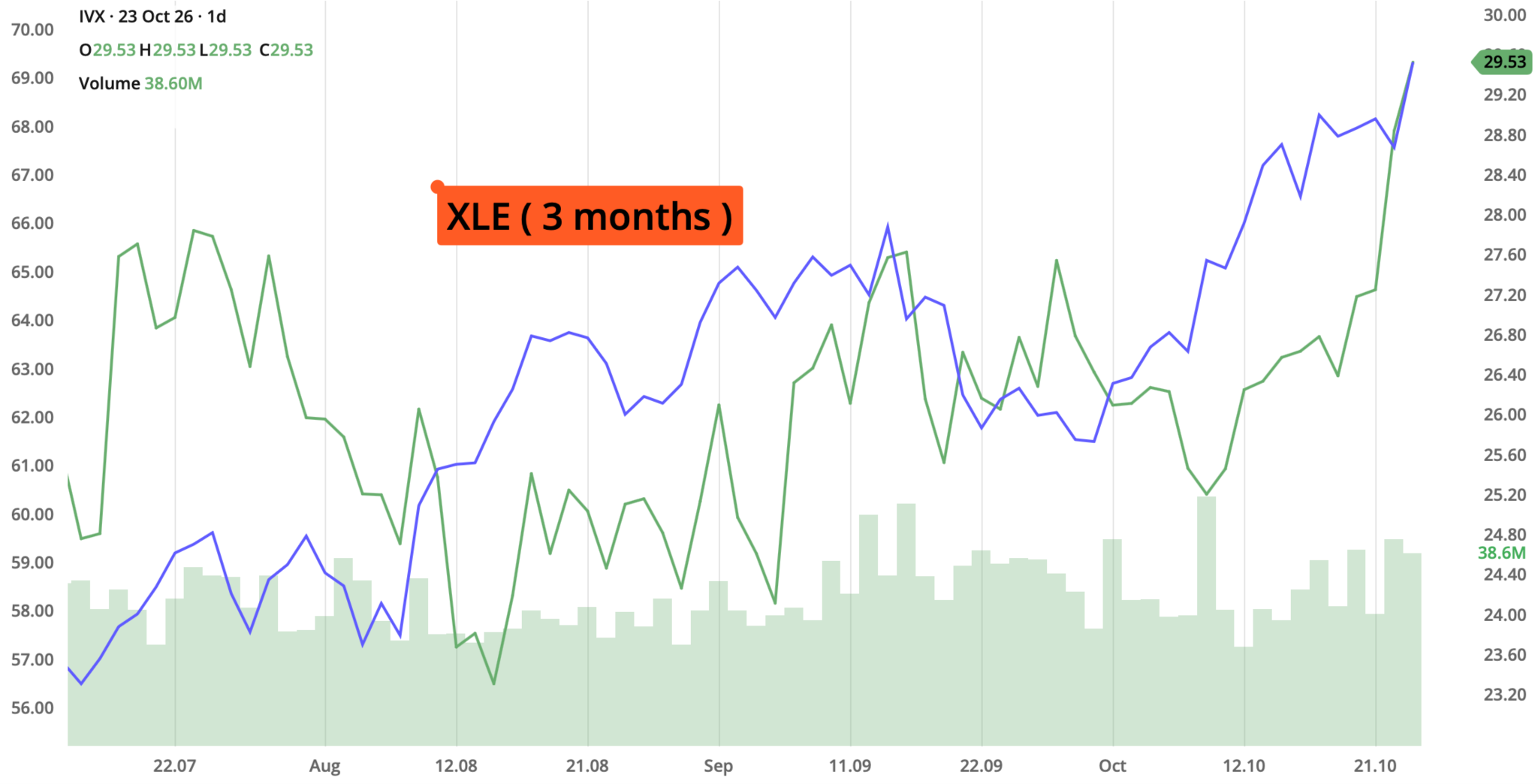
| ENERGY XLE | 2.06% | |
| HEALTHCARE (XLV) | 2.13% | |
| UTILITIES (XLU) | 0.97% | |
| MATERIALS (XLB) | 1.10% | |
| REAL ESTATE (XLRE) | 1.19% | |
| CONSUMER STAPLES (XLP) | 1.53% | |
| CONSUMER DISCRETIONARY (XLY) | 0.15% |
Notable Gainers Week of Oct 19th – 23rd
Defensive positioning, energy strength, and selective corporate catalysts drove outperformance across specific high-liquidity components. As surging Brent crude prices and elevated Treasury yields put pressure on high-valuation growth components, capital rotated toward energy producers, cash-generative value, defensive healthcare, and select corporate buyback or M&A beneficiaries. Several prominent equities posted strong weekly gains against the broader market pullbacks.
- Cleveland-Cliffs Inc. (CLF): Surged over 16%, leading notable large-cap gainers as surging raw material prices and domestic steel demand projections spurred heavy buying interest.
- Genmab A/S (GMAB): Jumped nearly 9.5%, outperforming the broader biotech sector following strong clinical updates and defensive inflows into high-margin pharmaceutical platforms.
- Venture Global Inc. (VG): Advanced over 9%, capitalizing on the broader energy sector rally as surging natural gas and liquefied energy export demand lifted midstream and LNG infrastructure providers.
- Maplebear Inc. / Instacart (CART): Rose over 9%, defying growth equity headwinds as positive consumer engagement metrics and margin expansion outlooks drew buyer interest.
- Robert Half Inc. (RHI): Rallied over 8%, benefiting from earnings-driven momentum and favorable corporate staffing guidance amidst resilient labor market data.
Notable Losers Week of Oct 19th – 23rd
Global growth, high-beta tech, and fuel-sensitive industries were pressured as surging energy costs and sticky benchmark yields unsettled investors. With Brent crude climbing above $116 per barrel and the 10-year Treasury yield anchoring near 5.00%, corporate cost structures faced acute pressure—particularly across communication services, high-capex tech infrastructure, and transport sectors. As institutional capital sought refuge in energy producers and traditional cash-generative value, several prominent large-cap components posted significant weekly losses.
- Sea Limited (SE): Tumbled over 20%, leading large-cap decliners as intensifying competition across Southeast Asian e-commerce and fintech margins prompted severe institutional profit-taking.
- Graco Inc. (GGG): Dropped over 18%, hit by broad weakness across industrial equipment manufacturers as surging input costs and elevated borrowing rates weighed on capital expenditure forecasts.
- TAL Education Group (TAL): Fell over 15%, pulling back alongside broader emerging market growth equities under pressure from a firming U.S. dollar and macro rate headwinds.
Review selected market indices below:
Daily Notable Market Action
Market Summary for Monday, Oct 19th
Equities: Equities opened the week with modest gains, attempting to rebound as technology shares stabilized following the prior week's heavy liquidation.
(S&P 500 Close: 7,690.73)
Bonds: Fixed-income markets remained under pressure as benchmark yields held near elevated cycle boundaries amid sticky inflation data.
(10-Year Treasury Yield Close: 5.15%)
Oil: Crude oil gained traction amid escalating Middle East geopolitical friction and physical market supply tightness.
(Crude Oil Close: $101.85)
Gold: Gold traded firmly near recent consolidation levels, benefiting from underlying safe-haven support.
(Gold Close: $4,162.40)
Digital assets: Digital assets consolidated within an established technical channel as institutional trading volume remained light.
(Bitcoin Close: $81,420.00)
Market Summary for Tuesday, Oct 20th
Equities: Equities pushed slightly higher led by defensive healthcare and consumer staples, though upside was capped by fuel cost anxieties.
(S&P 500 Close: 7,712.57)
Bonds: Fixed-income markets saw a slight bid as long-term yields pulled back modestly from session highs.
(10-Year Treasury Yield Close: 5.12%)
Oil: Crude oil pushed further past $102 per barrel as supply disruption concerns continued to build.
(Crude Oil Close: $102.30)
Gold: Gold experienced mild profit-taking as real yields and the U.S. dollar held firm.
(Gold Close: $4,125.80)
Digital assets: Digital assets edged lower in lockstep with high-beta growth equities.
(Bitcoin Close: $81,150.00)
Market Summary for Wednesday, Oct 21st
Equities: Equities notched their strongest session of the week as a mid-week pullback in bond yields sparked short-covering across mega-cap growth names.
(S&P 500 Close: 7,757.17)
Bonds: Fixed-income markets rallied as bond buyers emerged, driving benchmark yields lower across the duration curve.
(10-Year Treasury Yield Close: 5.13%)
Oil: Crude oil extended its multi-week rally, breaking above $103 on persistent global supply constraints.
(Crude Oil Close: $103.10)
Gold: Gold stabilized above psychological support as lower bond yields temporarily offset dollar strength.
(Gold Close: $4,085.20)
Digital assets: Digital assets ticked up alongside broad risk assets, though trading volume remained range-bound.
(Bitcoin Close: $81,680.00)
Market Summary for Thursday, Oct 22nd
Equities: Equities turned sharply lower as cautious positioning ahead of upcoming mega-cap tech earnings triggered broad-based institutional selling. META fell 7% after reporting first negative free cash flow quarter since its IPO.
(S&P 500 Close: 7,663.43)
Bonds: Fixed-income markets gained ground as safe-haven capital trickled into Treasuries, driving yields below the 5.00% mark.
(10-Year Treasury Yield Close: 4.96%)
Oil: Crude oil pulled back beneath $100 as energy traders took profits following several consecutive sessions of gains.
(Crude Oil Close: $99.47)
Gold: Gold faced accelerated liquidation pressure as market participants rotated into liquid cash and short-duration paper.
(Gold Close: $4,042.10)
Digital assets: Digital assets slipped back toward lower support bounds amidst broader risk-off equity sentiment.
(Bitcoin Close: $81,306.00)
Market Summary for Friday, Oct 23rd
Equities: Equities closed out the week on a weak note as a sharp rebound in energy prices and rising Treasury yields weighed heavily on broad index components.
(S&P 500 Close: 7,623.68)
Bonds: Fixed-income markets faced renewed selling, pushing the benchmark 10-year yield back up to key psychological levels.
(10-Year Treasury Yield Close: 5.00%)
Oil: Crude oil surged nearly 4% on the session, settling at multi-year highs due to worsening supply friction in the Middle East.
(Crude Oil Close: $103.27)
Gold: Gold dipped under the $4,000 threshold to test multi-week lows before finding late-session buyers.
(Gold Close: $3,999.90)
Digital assets: Digital assets ended the week essentially flat, holding near multi-week support amidst subdued retail and institutional activity.
(Bitcoin Close: $81,076.80)
Notable Earnings Due for week of Oct 26th–30th
Corporate earnings season hits its peak velocity during the week of October 26th–30th, anchored by a massive wave of mega-cap tech, industrial, healthcare, and energy reports. Highlighting the slate are heavyweights like GOOGL, MSFT, AMZN, LLY, XOM and CVX. Market participants will be paying close attention to cloud infrastructure capital expenditures, AI monetization timelines, consumer spending resilience, and margin commentary against the backdrop of elevated interest rates and high energy costs.
The actual earnings date may vary, so traders should confirm with their brokers. If a trader wishes to open a position to participate in earnings announcements, it is important to check whether the earnings are released BEFORE the markets open or AFTER the markets close on the date of earnings.
Mon, Oct 26th: AMKR / CDNS / NUE / PFG / PSA / VZ / WELL / WHR
Tue, Oct 27th: BA / ENPH / EQT / HOOD / KO / PYPL / RCL / STX / UPS / V / WM
Wedn, Oct 28th: ADP / BSX / FTNT / GEV / GOOGL / MSFT / NOW / PSX / TMUS / UBS / VRT
Thu, Oct 29th: AAPL / AMZN / CAT / COIN / LLY / MA / META / NEM / SBUX / SO / VLO / WMT
Fri, Oct 30th: ABBV / CQP / CVX / PSX / XOM
Economic Calendar Due for week of Oct 26th–30th
The macroeconomic schedule for the week of October 26th–30th is packed with high-stakes potential market movers, headlined by the Federal Reserve's interest rate decision and press conference on Wednesday. Surrounding the central bank's announcement are critical readings on consumer health, durable manufacturing demand, third-quarter economic expansion, and the Fed’s preferred inflation metric. With energy costs elevated and benchmark yields oscillating near key cycle thresholds, these economic releases will serve as pivotal tests for monetary policy expectations and growth sustainability.
Monday, October 26th
- Chicago Fed National Activity Index & Dallas Fed Manufacturing Index
These regional survey metrics evaluate underlying national economic activity and manufacturing health across the Southwest. Strong expansion prints could reinforce sticky rate concerns, whereas deteriorating business conditions could signal broadening macro deceleration under elevated borrowing costs.
Tuesday, October 27th:
- S&P/Case-Shiller Home Price Index, Durable Goods Orders, CB Consumer Confidence, & Richmond Fed Manufacturing Index
This slate provides a detailed look into manufacturing capital expenditures, housing price resilience, and household economic sentiment. Capital goods orders offer a window into business investment momentum, while consumer confidence readings highlight how persistent inflation and elevated borrowing rates are impacting broad consumer behavior.
Wednesday, October 28tht
- Advance Goods Trade Balance, Wholesale Inventories, & FOMC Interest Rate Decision and Press Conference
The FOMC rate decision and subsequent press conference dominate the week's macroeconomic landscape. Investors will scrutinize the policy statement and Fed Chair commentary for guidance on interest rate trajectories, balance sheet runoff, and the central bank's assessment of sticky inflation against current economic conditions.
Thursday, October 29th
- Q3 GDP (Advance Estimate), Advance PCE Price Index, & Weekly Initial Jobless Claims
The initial third-quarter GDP estimate offers the comprehensive benchmark reading on U.S. economic growth, while the embedded PCE price index provides an immediate pulse on core inflation trends. Combined with weekly jobless claims, these figures will test whether domestic economic expansion remains resilient alongside labor market stability.
Friday, October 30th
- Personal Income & Outlays, Core PCE Price Index, & UMich Consumer Sentiment (Final)
As the Fed's primary measure of inflation, the Core PCE report directly influences interest rate expectations and broader market valuations. Personal spending and income data will illustrate whether household balance sheets continue to support private consumption amidst tight credit and rising energy prices.
Blue Sky Horizons
The Great NeoCloud Reckoning: Consolidation, High Debt Yields, and the Shift to Sovereign AI
Following our exploration of the rise of the NeoCloud economy, the specialized GPU-cloud sector is now entering a pivotal phase of structural friction and strategic evolution. While early movers successfully secured billions in venture capital and asset-backed debt to deploy GPU clusters, the landscape is rapidly shifting from aggressive capital deployment to rigorous balance sheet scrutiny.
- High Debt Costs and Capital Market Strain
The aggressive infrastructure scaling model—reliant on debt-financed GPU purchases collateralized by long-term capacity agreements—is hitting a wall of higher borrowing costs. Unsecured debt yields for major GPU operators have expanded significantly, while credit default protection costs have ticked up across the space. As investors re-evaluate the payback periods on massive compute investments, access to cheap capital is tightening, creating a sharp divide between well-capitalized market leaders and cash-strapped niche hosts. - Emerging Consolidation and Hyperscaler Counter-Offensives
Industry analysts expect a wave of consolidation, predicting that a significant portion of independent NeoCloud operators could be absorbed or forced to pivot by the end of the decade. The legacy hyperscalers (AWS, Azure, GCP) are not remaining passive; they continue to roll out custom silicon options (such as internal inferencing chips) alongside lower-cost reserved instances, squeezing margins for pure-play GPU aggregators. Consequently, smaller alternative cloud providers without multi-gigawatt power access or investment-grade customer anchor contracts could face severe margin compression. - The Rise of Sovereign AI and Alternative Hyperscalers
Despite financing hurdles, underlying demand for AI compute could remain structurally strong, but its direction is evolving. National digital initiatives and sovereign AI mandates are expanding globally as governments invest heavily to build localized, in-country compute infrastructure. Furthermore, a tier of "alternative hyperscalers" is emerging by pairing GPU-native architectures with open, multi-cloud management frameworks.
For options traders monitoring macro tech trends, the NeoCloud sector highlights a growing divergence between physical AI infrastructure costs and market valuations. While high-beta tech equities may face pressure from rising debt servicing costs and massive capex cycles, volatility in the space could present selective opportunities in defined-risk options strategies—such as call diagonals or iron condors—around major earnings announcements and capital expenditure updates from cloud hyperscalers and chipmakers alike.
TAKEAWAYS
For self-directed investors and options traders tracking this infrastructure shift, several public tickers could be worth adding to active focus lists to track balance sheet health, power access, and macro tech exposure:
- Hyperscalers & Legacy Partners (ORCL, MSFT, AMZN, GOOGL):
The major enterprise cloud platforms provide primary exposure to high-margin AI compute while maintaining investment-grade balance sheets and custom silicon initiatives. - Specialized Cloud & Infrastructure Pure-Plays (CRWV, NBIS, APLD):
Dedicated GPU clouds and high-density hosting platforms offer direct sensitivity to GPU-as-a-Service demand, though their elevated capital expenditures and credit terms demand rigorous risk monitoring. - HPC & Hybrid Energy Conversion Operators (IREN, HUT, WULF, CORZ):
Next-generation compute operators converting high-megawatt power infrastructure into dedicated AI data centers represent an evolving hybrid model with varying degrees of project-level debt risk. - Hardware & Silicon Anchors (NVDA, AMD):
As primary suppliers of the underlying computer hardware, chipmakers remain central indicators for global data center expansion and capital spending trajectories across both hyperscalers and NeoCloud operators.
Thank you for reading. Until next week's close,
Have a safe and productive Trading week!
Fauzia Timberlake
About the Author: Fauzia Timberlake is a professional options coach and financial strategist specializing in risk management and portfolio architecture for self-directed investors. She is Founder and Managing Partner of Option Engines.
Questions / Comments
We're here to serve IVolatility users and we welcome your questions or feedback about the option strategies discussed in this newsletter. If there is something you would like us to consider and/or analyze, we're always open to your suggestions. Use support@ivolatility.com.
Previous issues are located under the Trade Ideas tab on our website.